


Modern broadband connections need advanced standards for top performance. The Data Over Cable Service Interface Specification is key to today’s cable internet.
DOCSIS 3.1 brings big improvements to network abilities. It can handle download rates up to 10Gbps, which is ten times quicker than before.
Knowing about this upgrade is important for both providers and users. It makes streaming, gaming, and work better on the same coaxial cables.
The certification standards help systems work together well. This means better service and faster internet for everyone.
Understanding DOCSIS Technology Fundamentals
DOCSIS technology has changed how data moves through coaxial networks. It lets cable providers offer fast internet and TV on the same lines. This tech works well with older systems, making it efficient and compatible.
The Evolution of Cable Internet Standards
DOCSIS standards have evolved a lot. It started with DOCSIS 1.0, which offered basic internet. This was the start of data-over-cable services.
DOCSIS 2.0 improved upload speeds, meeting the need for faster two-way communication. This was a big step for internet users.
DOCSIS 3.0 brought a big change with channel bonding. This combined channels for more bandwidth. It allowed for faster internet without needing new cables.
DOCSIS 3.1 is the latest and best. It uses advanced tech for speeds of over a gigabit. It’s fast and efficient.
Related Posts:
- What Is HCI in Information Technology Human-Computer…

- The Advantages of Modern Technology Efficiency and…

- What Is Remote Technology Tools for Telework and…

- How Technology Is Helpful for Students Enhancing…

- What Is IFP in Technology Interactive Flat Panels in…

- What Is Mining in Blockchain Technology Securing and…

How DOCSIS Enables Data Over Cable Networks
DOCSIS lets data travel on the same cables as TV. It uses different frequencies for internet and TV. This keeps them from getting mixed up.
It uses special ways to send data through the cable. At the other end, it’s turned back into digital data. This is how we get internet.
At the provider’s end, there’s a system called CMTS. It manages all the internet traffic. It makes sure everything runs smoothly.
DOCSIS keeps TV working while giving us internet. It uses the cable wisely. This is one of its key advantages.
It’s designed to be upgraded bit by bit. This saves money and improves service. It means we get faster internet without having to replace everything.
What Is DOCSIS 3.1 Technology
DOCSIS 3.1 is a big step up in cable internet tech. It brings faster speeds than before and works with old systems. This means you can get speeds like fibre without changing your setup.
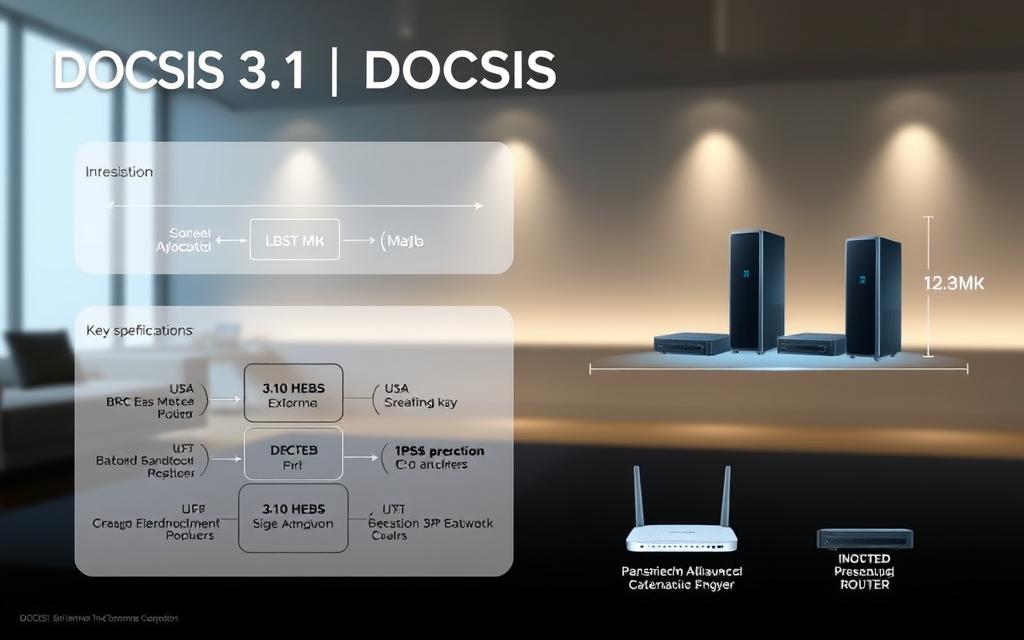
Key Technical Specifications and Improvements
The DOCSIS 3.1 specifications bring new tech for better performance. Orthogonal Frequency Division Multiplexing (OFDM) is used instead of old methods. This makes data transfer more efficient and reduces signal problems.
Other key updates include:
- Low Density Parity Check error correction for better data integrity
- Multi-carrier modulation techniques for better signal quality
- QAM 4096 support for higher data density per symbol
- Advanced security protocols for enhanced network protection
DOCSIS 3.1 can now offer download speeds up to 10 Gbps and upload speeds of 1-2 Gbps. This is thanks to its efficiency, allowing providers to offer gigabit speeds without big changes to their networks.
The Shift from DOCSIS 3.0 to 3.1
The move from DOCSIS 3.0 to 3.1 is a big leap. DOCSIS 3.0 maxed out at about 1 Gbps, but DOCSIS 3.1 goes up to 10 Gbps. It also uses Orthogonal Frequency Division Multiple Access (OFDMA) for better upload speeds.
What’s great is that DOCSIS 3.1 works with DOCSIS 3.0 gear. This lets internet providers upgrade slowly while keeping customers happy. It’s a smart way to update without spending a lot of money right away.
Technical Architecture of DOCSIS 3.1
The DOCSIS 3.1 architecture is a big step forward in cable internet technology. It changes how data moves through coaxial networks. It uses new modulation techniques, better spectrum use, and smart traffic management to boost performance.
OFDM and SC-QAM Modulation Techniques
DOCSIS 3.1 uses a new way to send data called Orthogonal Frequency Division Multiplexing (OFDM). This is different from the old Single Carrier Quadrature Amplitude Modulation (SC-QAM). This change is a big deal for how data is sent.
OFDM splits the spectrum into many small parts. Each part carries a bit of data. This makes signals stronger and less prone to interference. It also keeps old systems working by supporting SC-QAM for them.
“The move to OFDM is the biggest change in cable modem tech in years”
Channel Bonding and Spectrum Efficiency
DOCSIS 3.1’s channel bonding makes it very efficient. It lets many channels work together at once. This means a lot more data can be sent than before.
It can bond hundreds of channels, unlike DOCSIS 3.0’s 8-32. This means about 50% more data can be sent in the same space. It’s more efficient because it uses bandwidth better and has less overhead.
| Feature | DOCSIS 3.0 | DOCSIS 3.1 | Improvement |
|---|---|---|---|
| Maximum Channels | 32 | 192+ | 600% |
| Spectrum Efficiency | 6.4 bps/Hz | 10.5 bps/Hz | 64% |
| Channel Width | 6-8 MHz | 24-192 MHz | 300% |
Active Queue Management and Latency Reduction
Active Queue Management (AQM) is key in DOCSIS 3.1. It watches the network and sorts traffic to cut down on delays. It’s great for fast applications like gaming and video calls.
AQM finds and fixes problems before they happen. This keeps the network running smoothly, even when it’s busy. It cuts down on delays and makes sure applications work well.
These changes make DOCSIS 3.1 perfect for today’s internet needs. It handles lots of devices and keeps latency low. It’s reliable and fast.
Speed Capabilities and Performance Metrics
Understanding DOCSIS 3.1’s speed and performance is key for internet providers and users. We’ll look at its fast speeds, real-world use, and how it handles network demands.
Download and Upload Speeds
DOCSIS 3.1 boosts cable internet, reaching up to 10 Gbps for downloads and 2 Gbps for uploads. This is a big jump from older standards.
It’s great for working from home and video calls. The faster upload speeds make these activities smoother.
Real-World Performance vs Theoretical Maximums
The actual speeds of DOCSIS 3.1 vary. Your provider’s network, speed plans, and local setup affect what you get.
Providers now offer speeds from 300 Mbps to 1 Gbps for downloads. Uploads range from 35 Mbps to 100 Mbps. These speeds are a big upgrade for most users.
“The gap between theoretical and actual speeds shows tech limits and provider choices. DOCSIS 3.1 sets the stage, but how it’s used affects your experience.”
Even with DOCSIS 3.1, network congestion can slow things down. But it’s better than older tech.
Impact on Network Congestion and Peak Usage
DOCSIS 3.1 keeps speeds steady during busy times. Its efficiency helps even when lots of users are online.
It fights congestion with better channel bonding, modulation, traffic management, and lower latency.
So, even when streaming is at its peak, DOCSIS 3.1 networks perform better than older ones.
| Time Period | DOCSIS 3.0 Performance | DOCSIS 3.1 Performance | Improvement |
|---|---|---|---|
| Evening Peak (7-11 PM) | 65-75% of advertised speed | 85-95% of advertised speed | 20-30% better consistency |
| Weekend Afternoon | 70-80% of advertised speed | 90-98% of advertised speed | 20-25% better consistency |
| Early Morning | 95-100% of advertised speed | 98-100% of advertised speed | 3-5% better consistency |
The table shows DOCSIS 3.1’s steady performance at different times. This is a big plus for users.
Providers also gain from this efficiency. They can serve more customers with the same infrastructure, keeping service quality high during busy times.
Backward Compatibility Considerations
DOCSIS 3.1 technology is designed with gradual implementation in mind. It doesn’t require immediate, full replacements. Instead, it smoothly integrates with existing cable infrastructure.
DOCSIS 3.1’s engineering lets internet service providers upgrade their networks step by step. This method reduces disruption and increases the value of current installations.
Integration with Existing DOCSIS 3.0 Infrastructure
DOCSIS 3.1 works perfectly with older systems like DOCSIS 3.0, 2.0, and 1.1. This means cable operators can add new tech to their networks without a complete overhaul.
This hybrid approach lets providers offer better services in upgraded areas while keeping standard services elsewhere. It’s a big win for both providers and users during the transition.
Network engineers can upgrade DOCSIS 3.1 in stages. They focus on areas needing faster speeds first. This strategy boosts performance and returns on investment.
Modem and Equipment Requirements
To enjoy DOCSIS 3.1, you need a compatible modem. These devices must work with both new and old DOCSIS systems.
DOCSIS 3.1 modems can automatically adjust to the network version. This ensures smooth connectivity, no matter the upgrade status.
When picking a modem, check it supports your provider’s DOCSIS 3.1 features. Not all DOCSIS 3.1 modems are the same, and features can differ.
| Equipment Type | DOCSIS 3.0 Compatibility | DOCSIS 3.1 Readiness | Recommended Use Case |
|---|---|---|---|
| Basic DOCSIS 3.0 Modem | Full Support | Limited to 3.0 Speeds | Existing 3.0 Networks |
| DOCSIS 3.1 Modem | Full Backward Compatibility | Full 3.1 Capability | Future-Proof Investment |
| Service Provider CMTS | Hybrid Operation Supported | Gradual Upgrade Path | Network Transition Periods |
| Network Nodes | Maintains Existing Service | Selective 3.1 Enablement | Targeted Performance Boost |
The transition to DOCSIS 3.1 shows how new tech can work with old investments. This approach makes DOCSIS 3.1 a wise choice for the cable industry.
Benefits for Internet Service Providers
Internet service providers get big benefits from using DOCSIS 3.1. It makes their old cable networks fast and strong, like fibre. This helps them work better, plan for the future, and stand out in the market.
Switching to DOCSIS 3.1 is a smart move, not a full rebuild. They can use their old coaxial networks but get speeds that meet today’s needs.
Network Efficiency and Cost Savings
DOCSIS 3.1 makes networks work better with new tech. It uses OFDM to send more data in the same space. This makes the most of what they already have.
This means providers save money. They don’t have to spend a lot on new fibre. They can offer fast speeds with what they already have. This keeps costs down and services strong.
It also makes managing the network easier. DOCSIS 3.1 helps with traffic and keeps things running smoothly. This means less work for providers and better service for users.
Future-Proofing Cable Infrastructure
DOCSIS 3.1 makes cable networks ready for the future. It supports more data and works better, so networks can grow with demand.
This tech is a smart upgrade, not a full change. As DOCSIS tech gets better, 3.1 stays compatible. This protects their investment for the future.
Providers can update bit by bit. This keeps services running without big disruptions. It also keeps improving network and user experience.
Competitive Advantages in the Market
DOCSIS 3.1 gives providers a big edge. They can offer speeds like fibre without the cost. This puts them ahead of fibre and 5G services.
It lets providers quickly add fast services where they already have coverage. They can meet demand fast, without the wait of building new stuff.
This means better marketing for providers. They can offer fast services and keep their costs down. Customers get great service, and providers stay efficient.
| Benefit Category | Specific Advantage | Impact on Operations | Competitive Value |
|---|---|---|---|
| Network Efficiency | Improved spectrum utilisation | Higher capacity without new cables | Lower cost per megabit |
| Cost Management | Reduced capital expenditure | Phased upgrade capability | Faster ROI on investments |
| Future Readiness | DOCSIS 4.0 compatibility path | Long-term infrastructure value | Technology leadership position |
| Market Position | Fibre-competing speeds | Service differentiation | Customer retention improvement |
The strategic value of DOCSIS 3.1 goes beyond just fast speeds. It sets the stage for more innovation and growth. Providers who use it stay relevant and grow.
This smart way to update networks keeps cable internet strong. It’s a good choice for fast internet, helping providers and users alike.
Advantages for Home and Business Users
DOCSIS 3.1 technology brings big improvements for both home and business internet users. These benefits make daily online activities better, whether for fun, work, or managing devices.

Enhanced Streaming and Gaming Experiences
The tech’s lower latency means smoother online interactions. Gamers see better response times in online games. Streaming services get consistent bandwidth.
4K and ultra-high-definition content loads smoothly without breaks. Video calls stay clear even in long meetings. These changes make using bandwidth-heavy apps feel smooth.
Support for Multiple Connected Devices
Today’s homes and offices use many devices at once. DOCSIS 3.1 handles this well without slowing down. It uses advanced channel bonding to share bandwidth smartly.
Smart homes work better with lots of devices connected. Offices stay productive even when busy. The system automatically sorts traffic based on what you need.
| Device Type | DOCSIS 3.0 Performance | DOCSIS 3.1 Performance | Improvement Percentage |
|---|---|---|---|
| 4K Streaming Devices | 2-3 simultaneous streams | 5-7 simultaneous streams | 140% increase |
| Gaming Consoles | 45-60ms latency | 15-25ms latency | 60% reduction |
| Video Conferencing | 720p quality | 1080p/4K quality | 50% quality improvement |
| Smart Home Devices | 20-25 devices supported | 50-60 devices supported | 150% capacity increase |
Improved Reliability and Consistency
Network stability is key for those who rely on the internet. DOCSIS 3.1 keeps performance steady, even when lots of people are online. It stops slowdowns by managing queues actively.
Businesses face fewer interruptions during important tasks. Home users enjoy uninterrupted streaming. Cloud apps work smoothly with little delay.
Large files transfer faster with steady speeds. Backup and data sync happen more efficiently. These improvements make DOCSIS 3.1 great for all kinds of use.
Implementation Requirements and Challenges
Switching to DOCSIS 3.1 means big investments in infrastructure and new equipment for users. This technology boosts performance, but setting it up is tough for both service providers and users.
Cable Provider Infrastructure Upgrades
Internet providers need to update their networks for DOCSIS 3.1. They must upgrade cable modem termination systems (CMTS) with new hardware and software. This is key for handling advanced modulation.
They also need to improve network optimisation. This means supporting higher frequencies and better signal quality. Old amplifiers and nodes need to be replaced.
Upgrades cost a lot and can disrupt services. Providers must plan carefully to reduce customer impact and improve network performance.
Consumer Equipment and Modem Compatibility
Users need DOCSIS 3.1 compatible modems to enjoy the technology’s benefits. Old DOCSIS 3.0 equipment won’t work with the new standard. This adds extra costs for those wanting better services.
It’s not just modems that need to be compatible. Routers and network interfaces also play a part. Users should check their entire network setup can handle DOCSIS 3.1 speeds. Buying compatible equipment can save money in the long run.
The market has many DOCSIS 3.1 modems with different features. It’s important to research before buying. Make sure the modem works with your provider’s network.
Regional Deployment Timelines
When DOCSIS 3.1 is deployed varies by region and provider. Cities usually get upgrades before rural areas because of population density. Big cities often get it sooner than smaller towns.
Providers’ resources and priorities also affect when they deploy. Some focus on competitive markets first, while others tackle areas with old infrastructure. The table below shows typical deployment patterns:
| Region Type | Expected Timeline | Primary Challenges | Provider Priority |
|---|---|---|---|
| Major Metropolitan | 6-12 months | High population density | High |
| Suburban | 12-24 months | Infrastructure age | Medium |
| Rural | 24-36 months | Distance between nodes | Low |
| Remote | 36+ months | Cost of infrastructure | Variable |
For specific deployment info, contact your local provider. Many have rollout maps or availability checkers on their websites. The transition period requires patience due to challenges.
Weather and regulatory approvals can also delay deployments. Providers must work with local authorities and weather to ensure successful installations. These factors lead to varied timelines across regions.
Comparison with Fibre Optic and DSL Technologies
Choosing high-speed internet is a big decision. DOCSIS 3.1 is a good choice. It offers fast speeds and is easy to set up.
Performance Benchmarks Against Alternative Technologies
DOCSIS 3.1 is fast, almost as fast as fibre. Most people won’t see a big difference. It’s great for streaming, gaming, and video calls.
It beats DSL in every way. DSL can’t go over 100Mbps. But DOCSIS 3.1 can:
- Download speeds over 1Gbps
- Upload speeds up to 200Mbps
- Latency under 10 milliseconds
- Works well even when lots of people are online
DOCSIS 3.1 is perfect for homes with lots of devices. It handles lots of data well.
Cost-Effectiveness and Deployment Considerations
DOCSIS 3.1 is cheaper than fibre. It uses old coaxial cables. This saves a lot of money.
Here’s why it’s better:
- Fibre costs $15,000-$30,000 per mile
- DOCSIS 3.1 uses what’s already there
- DSL can’t keep up with today’s speeds
- Setting up DOCSIS 3.1 is faster
Providers like DOCSIS 3.1 because it’s fast and cheap. This means better deals for you.
It’s a smart choice for cable companies. They can keep up with fibre without spending a lot. This makes DOCSIS 3.1 great for many places.
Major Providers Offer DOCSIS 3.1 Services
Many top internet service providers in the US have adopted DOCSIS 3.1. This move is a big step towards better broadband. It shows a big investment in updating cable networks.
The rollout of DOCSIS 3.1 varies by provider and area. Some places have it fully, while others are waiting for upgrades. Most modems, like NETGEAR and Hitron, work with these services.
Comcast Xfinity and DOCSIS 3.1 Implementation
Comcast Xfinity leads in DOCSIS 3.1 deployment, reaching millions of users. They upgrade networks slowly but keep services running smoothly.
Xfinity offers fast speeds with DOCSIS 3.1. You can get speeds up to 1 Gbps in many areas. They support modems from NETGEAR, like the CM1000 and CM2000 series.
“Our DOCSIS 3.1 rollout is the biggest and fastest in the industry. It brings fast speeds to more homes than any other provider.”
Spectrum’s Rollout Strategy and Coverage
Spectrum is rolling out DOCSIS 3.1 in phases, starting with busy cities. They keep adding more areas every quarter.
Now, you can get DOCSIS 3.1 in big cities like New York and Los Angeles. Spectrum offers speeds up to 1 Gbps in these areas. They have a list of compatible modems, including NETGEAR and Hitron.
Spectrum is always growing their DOCSIS 3.1 network. They keep adding new areas to their coverage.
Cox Communications and Regional Availability
Cox Communications offers DOCSIS 3.1 in the west and south, but it varies by area. They have plans for both homes and businesses.
Places like Phoenix and Las Vegas have Cox’s DOCSIS 3.1. They’re also expanding to more places. You can see where it’s available on their website.
Cox supports many modems, including NETGEAR’s Nighthawk series. They’re always updating their network to bring DOCSIS 3.1 to more areas.
| Provider | Coverage Areas | Maximum Speed Tier | Compatible Modem Brands |
|---|---|---|---|
| Comcast Xfinity | Nationwide availability | 2 Gbps | NETGEAR, Hitron, Arris |
| Spectrum | Major metropolitan areas | 1 Gbps | NETGEAR, Hitron, Technicolor |
| Cox Communications | Select western/southern markets | 1 Gbps | NETGEAR, Hitron, Motorola |
Each provider is growing their DOCSIS 3.1 coverage. They update their maps and lists of compatible equipment often. Check with your provider for the latest on service in your area.
Future Developments: DOCSIS 4.0 and Beyond
Cable internet technology is getting better fast, with DOCSIS 4.0 leading the way. This new standard will make broadband faster and keep working with old systems.
Everyone is excited about the DOCSIS 4.0 future. It will bring new features and fix old problems, making internet better for everyone.
Upcoming Technological Advancements
DOCSIS 4.0 brings two big changes. Extended Spectrum DOCSIS (ESD) uses more frequencies, up to 1.8 GHz, for more data.
Full Duplex DOCSIS (FDX) is a game-changer. It lets data go both ways at the same time. This means faster uploads, which have always been slower than downloads.
These changes will bring:
- Fast speeds for both downloading and uploading
- Less delay for online activities
- More efficient networks during busy times
- Support for new tech like virtual reality and IoT
Long-Term Roadmap for Cable Internet
DOCSIS 4.0 is being rolled out slowly, starting in 2025. This careful plan lets providers test and update their systems step by step.
Cable companies are spending a lot to get ready for these upgrades. They need to update both hardware and software.
The table below shows how cable internet will keep getting better:
| Technology | Maximum Download Speed | Maximum Upload Speed | Expected Deployment |
|---|---|---|---|
| DOCSIS 3.1 | 10 Gbps | 1-2 Gbps | Currently deployed |
| DOCSIS 4.0 (ESD) | 10 Gbps | 6 Gbps | 2025-2026 |
| DOCSIS 4.0 (FDX) | 10 Gbps | 10 Gbps | 2026-2027 |
After DOCSIS 4.0, there are even more ideas to make cable internet better. These could include using more spectrum and new ways to send data.
With constant updates, cable internet stays competitive with fibre. This makes high-speed internet affordable for many homes and businesses.
As we look to the DOCSIS 4.0 future, we’ll see faster, more reliable internet. It will support new tech like AI, AR, and smart cities.
Conclusion
DOCSIS 3.1 is a big step forward in cable internet tech. It brings multi-gigabit speeds and works with old systems. This lets companies like Comcast Xfinity and Spectrum offer fast internet without changing everything.
This tech is a win-win. It gives users fast downloads and uploads, and better gaming and streaming. It also makes sure devices stay connected well.
For internet providers, DOCSIS 3.1 is a smart choice. It’s an upgrade that doesn’t cost too much but prepares for future needs. It makes cable internet as fast as fibre without the big changes.
Looking ahead, DOCSIS 3.1 is key for the future of cable internet. It keeps cable networks fast and reliable for homes and businesses in the US.
FAQ
What is DOCSIS 3.1 technology and how does it improve cable internet speeds?
DOCSIS 3.1 is the latest tech for fast internet over coaxial cables. It can reach speeds of up to 10Gbps downstream and 2Gbps upstream. This is thanks to new methods like OFDM and better error correction.
These changes make internet faster and more reliable than before.
How does DOCSIS 3.1 differ from DOCSIS 3.0?
DOCSIS 3.0 was fast, but DOCSIS 3.1 is even quicker. It uses OFDM and is more efficient. This means it can handle speeds of up to 10Gbps.
It also works better when lots of people are online at once.
Is DOCSIS 3.1 backward compatible with older DOCSIS versions?
Yes, DOCSIS 3.1 works with older versions. This makes it easy for providers to upgrade without a big change. It’s good for both providers and users.
What equipment do I need to use DOCSIS 3.1?
You need a modem that supports DOCSIS 3.1, like NETGEAR or Hitron models. Your provider must also update their network to use DOCSIS 3.1.
How does DOCSIS 3.1 benefit both providers and users?
Providers save money and future-proof their networks with DOCSIS 3.1. It also helps them compete with fibre services. Users get faster, more reliable internet for things like streaming and gaming.
How does DOCSIS 3.1 compare to fibre optic internet?
DOCSIS 3.1 is as fast as many fibre services, but it’s cheaper. It uses the existing coaxial network, saving on fibre costs. It’s a good choice for fast speeds without the high cost of fibre.
Which major providers offer DOCSIS 3.1 services?
Comcast Xfinity, Spectrum, and Cox Communications offer DOCSIS 3.1. Check with your provider for availability and compatible modems in your area.
What future developments can we expect in cable internet technology?
Next up is DOCSIS 4.0, with even faster speeds and lower latency. It will support new tech like virtual reality and AI. Expect these updates by 2025 and beyond.
Does DOCSIS 3.1 improve performance during peak usage times?
Yes, DOCSIS 3.1 keeps speeds steady even when lots of people are online. This means fewer slowdowns and a better experience for everyone.
Can DOCSIS 3.1 support a smart home or office with many connected devices?
Absolutely. DOCSIS 3.1 is perfect for homes or offices with lots of devices. It keeps speeds stable for streaming, gaming, and more, without slowing down.
 Marcin Wieclaw